China Best Gas Grill Manufacturers for Global Buyers
Choosing a reliable Gas Grill manufacturer requires more than comparing catalog photos and quoted prices. Global buyers must examine product quality, factory experience, export capability, and after-sales support. A supplier may offer polished stainless steel panels, powerful burners, and attractive packaging. Yet these details can hide weak welds or inconsistent heat control.
Steven Raichlen, a respected grilling authority, offers a useful reminder: “The best grill is the one you use.” That idea matters when evaluating manufacturers. A dependable Gas Grill should ignite smoothly, maintain steady heat, and remain practical after repeated outdoor cooking. Buyers should ask for burner specifications, material grades, inspection records, and clear warranty terms. Factory audits and sample testing add valuable evidence.
Real experience often appears in small details. Does the lid close evenly? Does grease drain without pooling? Can replacement parts arrive quickly? These questions can separate a serious manufacturer from a temporary trading company. No factory is perfect. Even established suppliers may show inconsistent finishing between production batches. That deserves honest discussion, not polished promises.
This guide introduces China’s leading Gas Grill manufacturers for global buyers. It considers production capacity, engineering expertise, customization, compliance awareness, and communication quality. The goal is not to praise every supplier equally. It is to help importers compare evidence, identify practical risks, and choose a partner suited to their market. Careful buyers should still verify current certifications and inspect samples independently. A strong introduction can narrow the field, but it cannot replace due diligence.
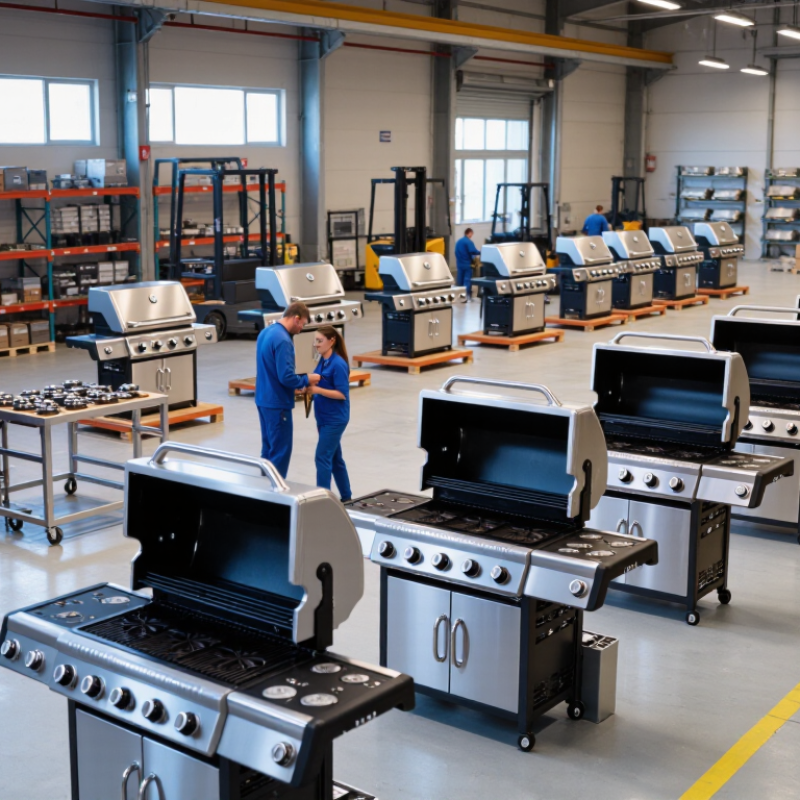
China’s Role in the Global Gas Grill Manufacturing Industry
China has become a central manufacturing base in the global gas grill industry. According to UN Comtrade data through ITC Trade Map, China remained a leading exporter under HS 732111 in 2023. This category includes gas-fuelled cooking appliances, although it is broader than grills. The data still shows China’s strong production capacity.
Its advantage comes from dense supplier networks. Steel processing, burners, valves, castings, packaging, and electronics can be sourced within relatively short distances. This reduces lead times and supports flexible OEM production. Industry reports from Grand View Research also indicate steady growth in the global outdoor cooking equipment market, driven by home entertaining and outdoor kitchens. However, low factory prices do not automatically mean reliable quality.
In practical sourcing, buyers should inspect burner flame stability, grease management, lid alignment, and corrosion resistance. Independent testing should verify applicable gas safety and electrical requirements for each destination market. A factory may provide attractive samples, yet production consistency can still vary. That weakness deserves honest attention.
Tips: Request a pre-shipment inspection, material certificates, gas-leak test records, and photographs from assembly lines. Compare warranty data, not only quotations. A slightly higher cost may reduce returns, delays, and safety concerns.
Major Types of Gas Grills Produced for International Markets
China’s gas grill manufacturers serve global buyers through several practical product categories. Freestanding grills remain popular because they offer mobility and simpler installation. Built-in models suit premium outdoor kitchens and fixed countertop designs. Portable Gas Grills target balconies, campsites, and compact urban spaces. Commercial modular grills support restaurants, hotels, and catering operations.
Allied Market Research estimated the global barbecue grill market at about USD 4.3 billion in 2021. Its report also projected approximately 5.2% annual growth through 2031. Gas models benefit from fast heating and adjustable temperature control. However, regional preferences still vary. European buyers may prioritize compact footprints and corrosion resistance. North American buyers often request larger cooking surfaces and multiple burners. Manufacturers should not assume one specification fits every market. That assumption can cause costly revisions.
Tips: Ask for burner-output testing, gas compatibility documents, and material certificates. Check whether stainless steel grades match humid or coastal conditions. Request photos of flame patterns and grease-management details. Independent inspection is wiser than relying only on factory samples. In practice, small issues matter. Uneven lid alignment, weak knobs, or difficult cleaning can damage user confidence. Buyers should also compare packaging tests, spare-part availability, and instruction quality before approving production. Safety verification should follow the destination market’s applicable requirements.
China Best Gas Grill Manufacturers for Global Buyers
Major gas grill types produced for international markets, compared by representative burner configuration.
The figures represent common burner configurations found in export-oriented product specifications. Portable grills typically use one or two burners, while commercial models commonly use four to eight burners. Actual configurations vary by cooking area, fuel system, certification requirements, and buyer customization.
Quality Standards, Certifications, and Export Compliance
For global buyers, a gas grill factory must prove more than attractive stainless steel. Grand View Research forecasts strong growth in the outdoor kitchen market through 2030, increasing pressure on suppliers to document quality. Certification is not decoration.
A capable manufacturer should control incoming steel, burner holes, valves, ignition systems, and hose connections. Batch records should identify heat numbers and inspection dates. ISO 9001:2015 supports this process through documented quality controls and corrective actions. However, a certificate alone proves little. Buyers should review current audit reports, calibration records, and failed-test handling.
For Europe, outdoor gas cooking appliances commonly require testing against EN 498 and compliance with Regulation (EU) 2016/426. The CE process should include technical files, risk assessment, instructions, and traceability labels. For North American shipments, buyers should request evaluation against ANSI Z21.58/CSA 1.6, where applicable. Export packaging also needs practical checks: drop testing, moisture protection, correct gas-pressure markings, and multilingual manuals. ISO 10204 inspection documents can strengthen material verification.
Small details matter. A loose burner bracket can create uneven flames. A poorly protected igniter may fail after sea transport. Factories sometimes inspect only finished units, which is not enough. In my experience, witnessing leak tests and ignition tests during production reveals more than reviewing polished brochures. Compliance still needs human judgment. That part is imperfect.
Sourcing, Customization, and Shipping from China
China Best Gas Grill Manufacturers for Global Buyers
Sourcing a gas grill from China requires more than comparing factory prices. Grand View Research has projected continued growth in the global outdoor grill market, with demand shaped by durability, convenience, and residential outdoor cooking. Buyers should request material certificates, burner performance records, and production samples before placing bulk orders. In practice, a sample may look polished while its lid alignment feels loose. That small detail matters.
Customization works best when specifications are measurable. Define cooking-surface dimensions, stainless-steel grades, ignition type, wheel structure, carton strength, and logo placement. For coastal markets, I recommend testing corrosion resistance and salt exposure. For colder regions, check ignition performance below normal room temperature. Requirements should also cover local gas connections, labeling, manuals, and approved safety testing. A factory’s answer should be documented, not merely promised.
Shipping planning needs equal attention. UNCTAD reports that maritime transport carries over 80% of global merchandise trade by volume, making port schedules and container availability important cost factors. Buyers should request quotations under clear Incoterms, then confirm carton measurements and loading plans. A few centimeters can change container efficiency. Consolidated shipments may reduce freight costs, but they can increase handling damage. The World Bank’s Logistics Performance Index also shows that customs and delivery reliability vary significantly between markets. I have seen buyers focus on the factory price and overlook inland transport, inspection, insurance, and destination charges. That approach needs reconsideration.


